The War of Nine Thousand at Chogha Khor
THE DOCUMENTED ACCOUNT
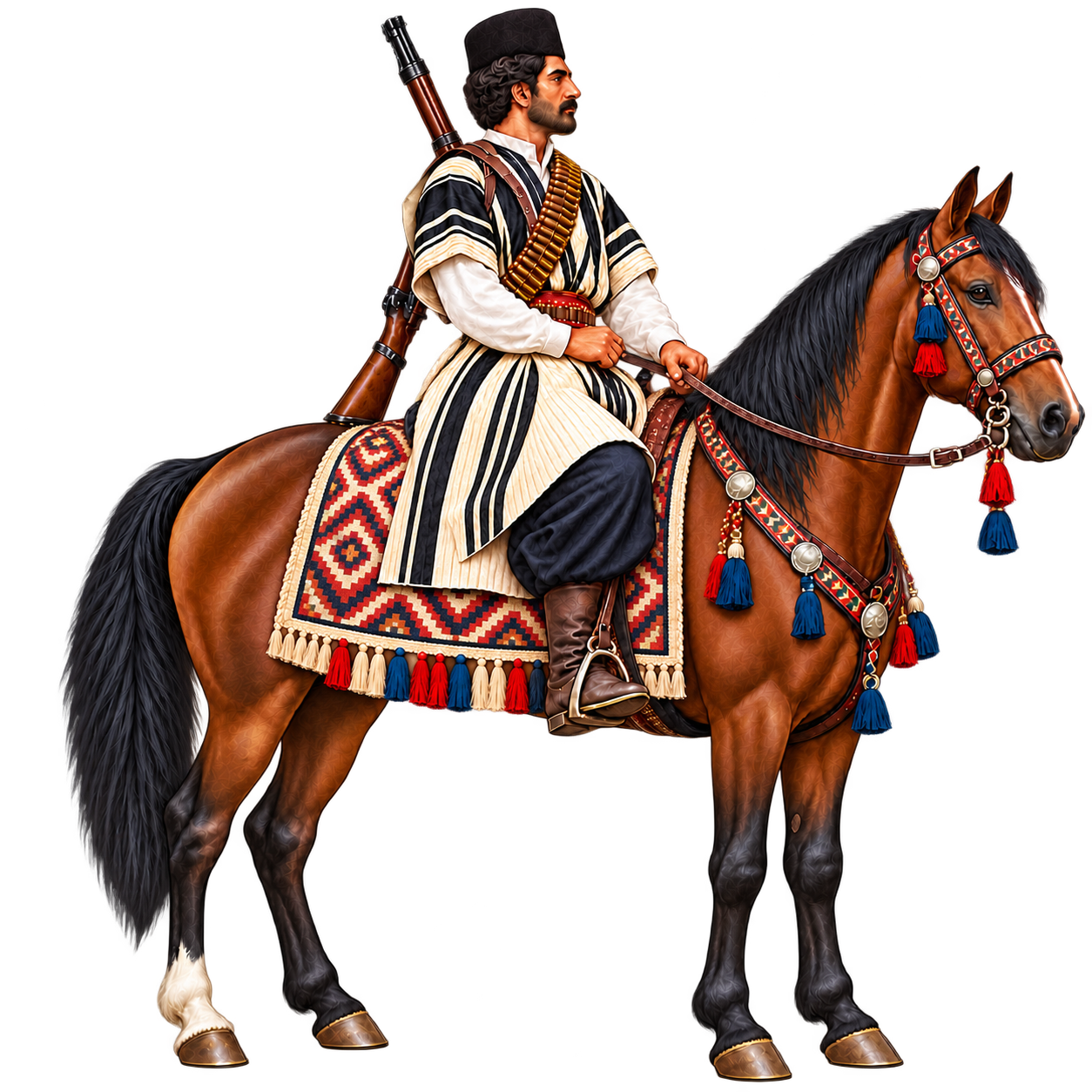
Ja'far Qoli Khan Bahadorvand — grandson of Tahmasb Khan Raki — raised a force of 9,000 riders and footmen from the Chahar Lang and Haft Lang tribes and marched on Chogha Khor, the summer base of the Duraki. The commander of the 9,000 was Anadali Raki, Ja'far Qoli Khan's maternal uncle. For ten nights the 9,000 dug in on the Chapi hill of Kalar. Anadali Raki rode his white horse in the Chogha Khor hollow and challenged the fortress, but no one came out. The Duraki had sent their families to the villages of Lenjan for safety. Inside the fortress were only seventy gunmen with Mulla Safar Ali and the pen-case of Mirza Masih. On the tenth day, forty Duraki riders volunteered and rode out. Eight hundred of the 9,000, led by Agha Nad Ali, charged them. Agha Nad Ali, on a white horse, was struck in the head by an arrow and fell. His horse ran into Kolbali Khan's riders; they chased it into the enemy camp, and the 9,000 — shaken by Anadali's fall — fled. The Duraki riders raised the Lori war cry and pursued. Ja'far Qoli Khan, son of Asad Khan, mounted Agha Nad Ali's white horse and fled toward Boldaji or Borujen. Hossein Khan, son of Farajollah Khan and the cause of this war, was too fat to escape; Rostam Arab reached him. Hossein Khan said, 'You have no right to kill me!' But Rostam, remembering the killing of Ja'far Qoli Khan at Minar, called Agha Mohammad Karim Khan, Kolbali's brother, who shot Hossein Khan with a rifle. It is said that 1,500 of the enemy were killed or died of hunger on the way, though this seems exaggerated. Sohrab Khan Chahar Lang stayed in the trench until he was killed — he was the father of Mehrab Khan. The women of the fortress came out to collect the rifles of the dead; each woman gathered ten rifles. One of the Chahar Lang chiefs of Mimand came to Kolbali Khan with ten riders instead of fleeing. The women seized their horses' bridles and made them dismount. Kolbali Khan, whose hands had been wounded in the previous night's raid, could no longer wield sword or rifle. It is said that in Bakhtiari he was the first rider, and in this war the fame of the Duraki and of Kolbali Khan rose across all Bakhtiari for manliness and bravery. My father was twelve years old in this war, and his brother Hajj Imam Qoli Khan was ten. The head of Agha Nad Ali, chief of the Raki and maternal uncle of Asad Khan's son, was cut off and brought to the fortress; Kolbali Khan kicked it from one side to the other. But he did not do the same with Sohrab Khan's head, because he had no old enmity with him. In this war, the mullas of the descendants of Farajollah Khan — like Mulla Amanollah and Mulla Farajollah, cousins of Mirza Ali Baz and Mirza Ali Panah — were killed because their trench was near the fortress. The mullas of Farajollah Khan's descendants were cousins of Mirza Mansour and were very brave and stout. In this war, the descendants of the late Sohrab Khan, Kolbali Khan's paternal uncle, stood at the head of Chal Dogh pass above Chogha Khor, waiting to see which side would win, so that they could join the victor. But their brother Agha Abdolkarim Khan, son of Sohrab Khan, whose house was in Deh Now of Chahar Mahal, when the fortress of Chogha Khor was besieged, wounded his own head with a dagger, threw a shroud around his neck, and came to the aid of Kolbali Khan. Not only here but in every event he helped, and our great chiefs always mentioned his name with respect. The daughter of the late Ja'far Qoli Khan, full sister of the late Ilkhani, my father, was given to Agha Mohammad Ali, his brother; and Hajieh Bibi, whose name was Nilufar and who was my full sister, was given to the son of Agha Abdolkarim. This Hajieh Bibi has property, a house, and furnishings, but no children, and has settled her estate on me and the children of Hajj Ali Qoli Khan Sardar Asad; she now lives in Safid Dasht, which belongs to her. At the time I began writing this history, five years ago, my sister was eighty-six. By a court ruling — God is witness that it was unjust — the property of Safid Dasht was taken from her, and no decision has yet been made in her case. Those who took part in the War of Nine Thousand were a few Aladdin-vand, cousins of Ja'far Qoli Khan Asad Khan-vand, who had been angry with Ja'far Qoli Khan for some years and had come to Kolbali Khan. They showed extraordinary manliness and bravery, but after a while they left Kolbali Khan and returned to Ja'far Qoli Khan. The reason was that they had a very expensive horse; the governor of the time in Arabistan heard of it and asked Kolbali Khan for it. Kolbali Khan, forced to give it, took the horse by force and gave it to the governor, though they had refused to give it. I admit he did not do well. Bibi Nilufar, daughter of Davoud Khan Bakhtiarvand, had also been given to Kolbali Khan's eldest son, Abdal Khan.
IN THE FAMILY RECORD
This chapter is connected to Anadali Raki, Kolbali Khan Duraki, Namdar Khan Monjzi Bahadorvand, Ja'far Qoli Khan Bahadorvand.
Sardar of the Bakhtiari Tribe (Zarasvand) · Alireza Emami · Kiumars Mahmoudi